Becoming a True Kavasseur…
How to know what's in your kava, and how to judge the bar that serves it
Wine lovers argue about Bordeaux versus Napa. Coffee people can taste the difference between Ethiopia and Guatemala. Kava drinkers are catching up fast, and we now have something those older obsessions took centuries to build: a shared quality standard.
In late 2024, the Kava Coalition released the Harmonized Multinational Kava Standards, a voluntary benchmark built by comparing the leading rulebooks for botanicals from the U.S., Europe, Australia and New Zealand, and the World Health Organization. Rather than picking the strictest or the loosest rule, the Coalition aimed for the middle ground and called the result "a gold standard" meant to harmonize them all. For the first time, the industry speaks a common language about quality. Every kavasseur should learn to read it.
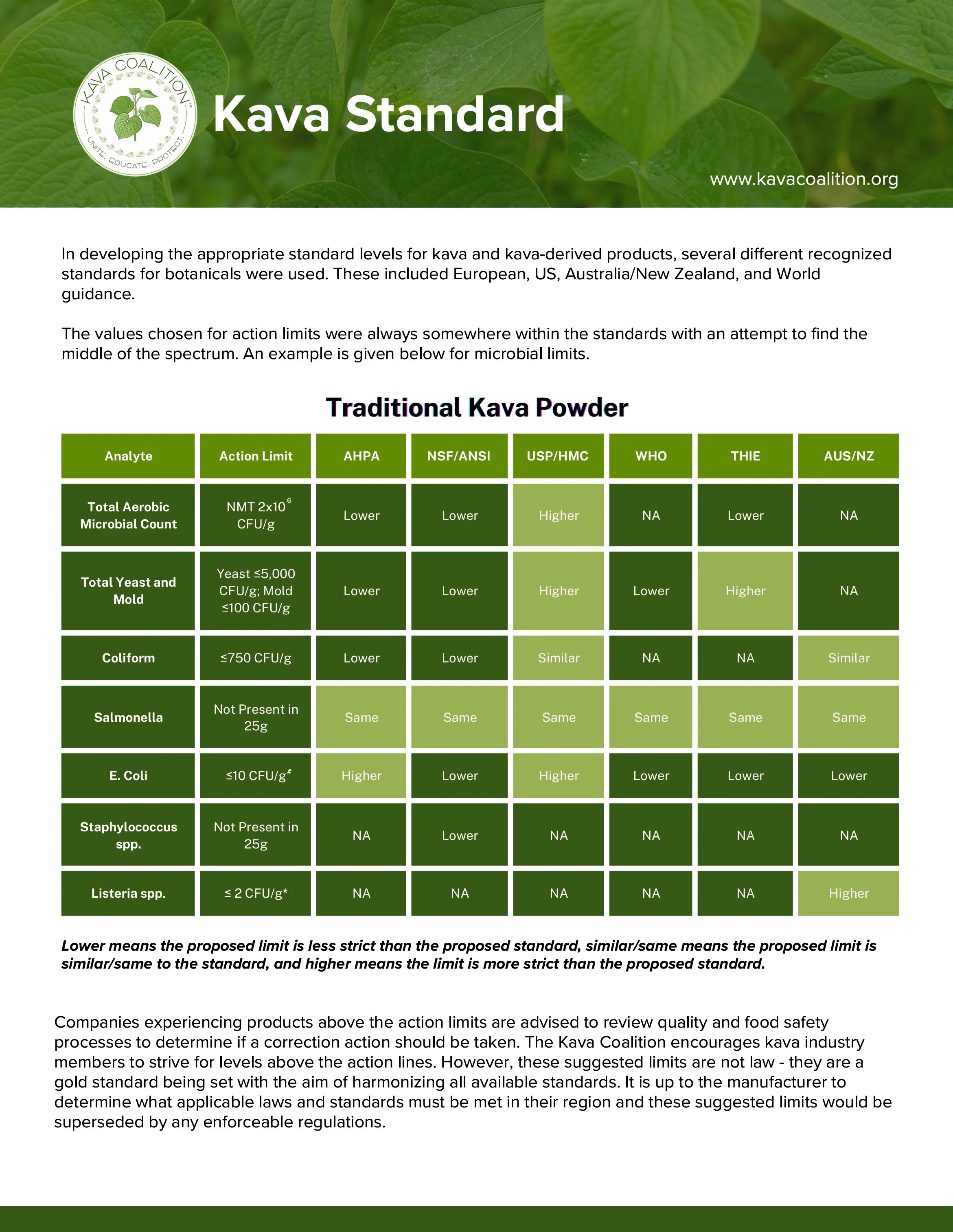
The current Kava Coalition standard guidelines working to unify kava quality analysis and control across multiple international health organizations
What a COA actually tells you
That language shows up on a certificate of analysis, or COA: kava's version of the back label. A good one answers three questions.
Is it real? The kava should be confirmed as a noble variety, never tudei. No exceptions.
What's in it? The kavalactone profile shows the balance of the active compounds that shape how a kava feels. This is where the connoisseur's fun lives. Flavokavains are measured here too, and in quality noble kava they stay low.
Is it clean? Labs screen for heavy metals, microbes, mold, moisture, pesticides, and residual solvents.
Why kava is different
Coffee is roasted and brewed hot. Beer and wine are fermented. Those steps do a lot of quiet work before anything reaches your glass. Kava gets none of that. It's a root that is washed, dried, ground, and kneaded by hand in cool water, the same way it has been prepared for generations.
That's the beauty of it. Kava is a raw, living food, closer to sushi or fresh-cut fruit than to a brewed drink. And like any raw food, it is only as good as the care it receives, from the farmer's field to the kavatender's hands.
The bar is the last lab
A kava can pass every lab test and still be let down at the counter. That makes your local bar part of the quality chain, and worth watching with a discerning eye.
Good signs: kavatenders wearing gloves while kneading, strainer bags that are rinsed, dried, and stored cleanly, clean shells and prep surfaces, and kava kept in sealed containers. Warning signs: an untidy prep area, careless handling, or a house kava that tastes and feels different every time you order it. Different origins should taste different. The same drink shouldn't.
Your kavasseur checklist
When a vendor or bar shares a COA, ask three things:
Does the lot number on the report match the bag?
Did an independent, accredited lab run the test, not the seller itself?
Do the microbial, metal, and mold results fall within the Coalition's action limits?
A vendor happy to hand over their COAs is a vendor proud of their product.
From there, the adventure opens up. Compare Fijian, Vanuatu, Tongan, and Hawaiian kavas the way you'd compare wine regions. Learn which kavalactone profiles suit you.
The trend is heading the right way
Shared standards are working. In the Coalition's independent market testing, the share of products meeting microbial limits rose from 49% in early 2025 to 73% by year's end. The same testing found no detectable heavy metals, pesticides, mycotoxins, or residual solvents, and confirmed authentic noble kava across the products sampled.
The science behind kava keeps getting stronger too. The American Herbal Pharmacopoeia calls kava "one of the safest and most effective botanical anti-anxiety herbs."
The more drinkers know what to look for, the higher the bar rises for everyone, in Arizona and across the country.
To learn more about your kavasseur journey, we encourage you to visit www.kavacoalition.org, where much of the difficult and important work is being done to bring kava to the masses, in the healthiest and most responsible way possible.